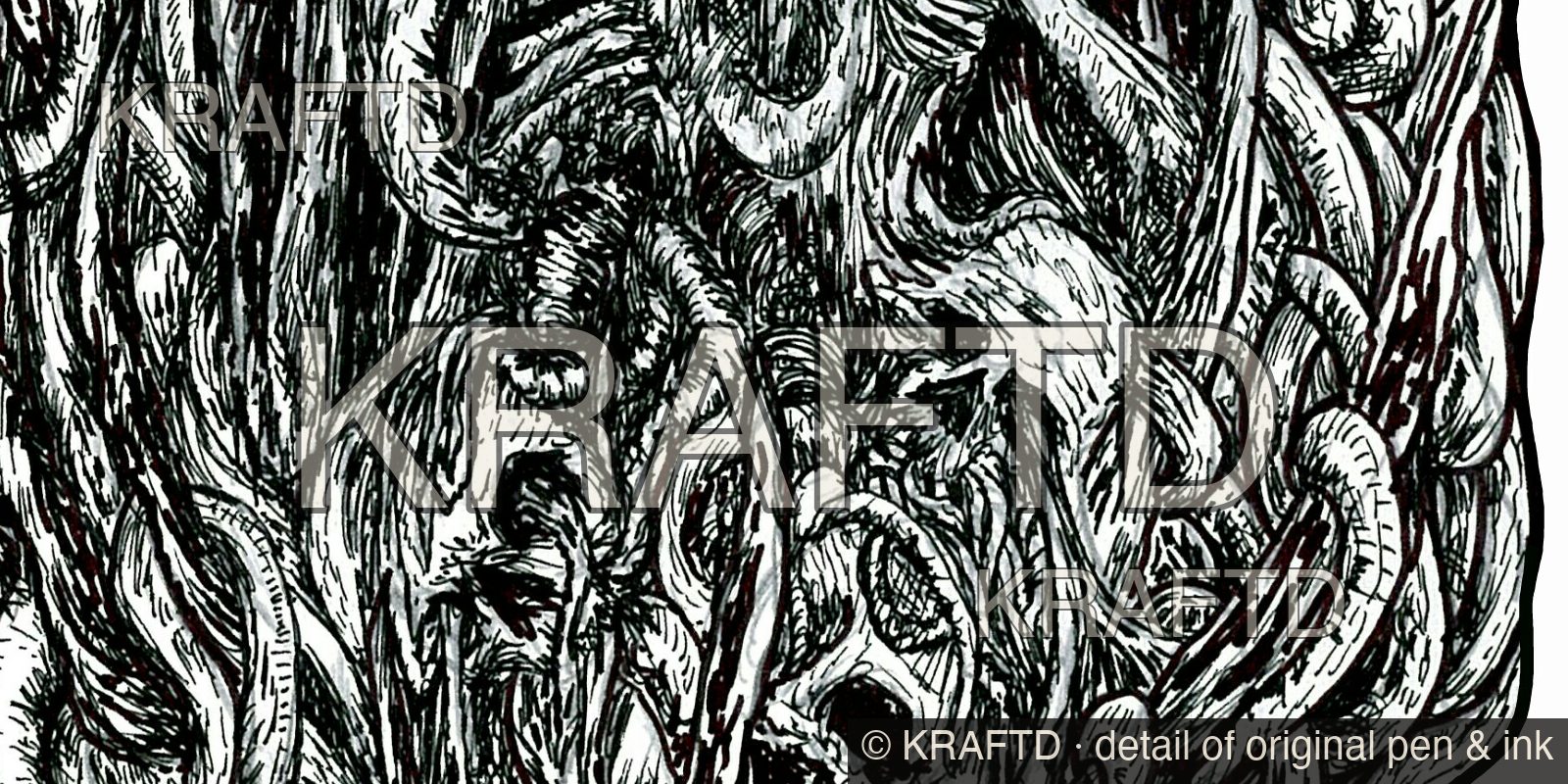
Every scene has its creatures. Black metal has the goat, the inverted cross and the frozen forest. Doom has the robed figure and the burning candle. Old-school death metal has always gone for the thing that should not exist: flesh where there should be bone, mouths where there should be eyes, bodies tangled into one another until you can’t tell where one ends.
Our best-selling design lives in that tradition, and it takes its name from one of the oldest monsters in Western writing: Behemoth.
The beast in the Book of Job
Behemoth first appears in the Hebrew Bible, near the end of the Book of Job. God answers Job’s suffering not with an explanation but with a tour of creation, and the tour ends with two monsters. One rules the sea: Leviathan. The other rules the land.
“Behold now behemoth, which I made with thee; he eateth grass as an ox.”
Job 40:15 (KJV)
The description builds from there. His strength is in his loins, his tail moves like a cedar, and “his bones are as strong pieces of brass; his bones are like bars of iron” (Job 40:18). No hunter can take him. He lies under the lotus trees and drinks the river dry without hurrying.
Scholars have argued for centuries about what the writer had in mind. Some say a hippopotamus, some an elephant, some a crocodile. Others say nothing that ever lived. The word itself is a plural form of the Hebrew behemah, “beast”, used as a singular: the Beast, the beast of beasts. That’s the point. Behemoth is not an animal. He’s a measure of how small a human is next to what is out there.
Leviathan, Behemoth and Ziz
Later Jewish tradition gave the land beast company. The Book of Enoch (1 Enoch 60) describes Leviathan as a female monster in the depths of the sea and Behemoth as a male monster holding a vast desert east of Eden. Rabbinic legend adds a third primordial creature, the giant bird Ziz, lord of the sky. Land, sea and air, each with its monster.
One legend says that at the end of days Behemoth and Leviathan will fight, or be slain, and their flesh will feed the righteous at a final banquet. It’s a strange image: the most unkillable thing in creation served up as a meal. It’s also a very metal one.
From monster to demon
As Christian demonology grew through the Middle Ages and the Renaissance, the old beasts were recast as demons. Behemoth became a demon of appetite: gluttony, the belly, the animal hunger that is never satisfied. The French occultist Jacques Collin de Plancy listed him in the Dictionnaire Infernal. The 1863 edition, illustrated by Louis Le Breton, shows him as a bloated, elephant-headed figure on hind legs. In some accounts he’s a butler or cupbearer at the infernal court, the demon who pours the wine at Hell’s feasts.
The name kept travelling. Thomas Hobbes used Behemoth as the title of his history of the English Civil War, a companion to his Leviathan. Mikhail Bulgakov gave it to the giant, gun-toting, chess-playing black cat in The Master and Margarita. Across all of these, Behemoth means one thing: something too big, too hungry and too strong to be controlled.
How our artist drew it, step by step
Our artist didn’t draw a hippo, an elephant or a cat. They drew the feeling of Behemoth: a thing made of hunger. Here’s how it came together, shown in close-up details from the original sheet. We only share details. The full drawing lives on the shirt.
1. Pen on paper
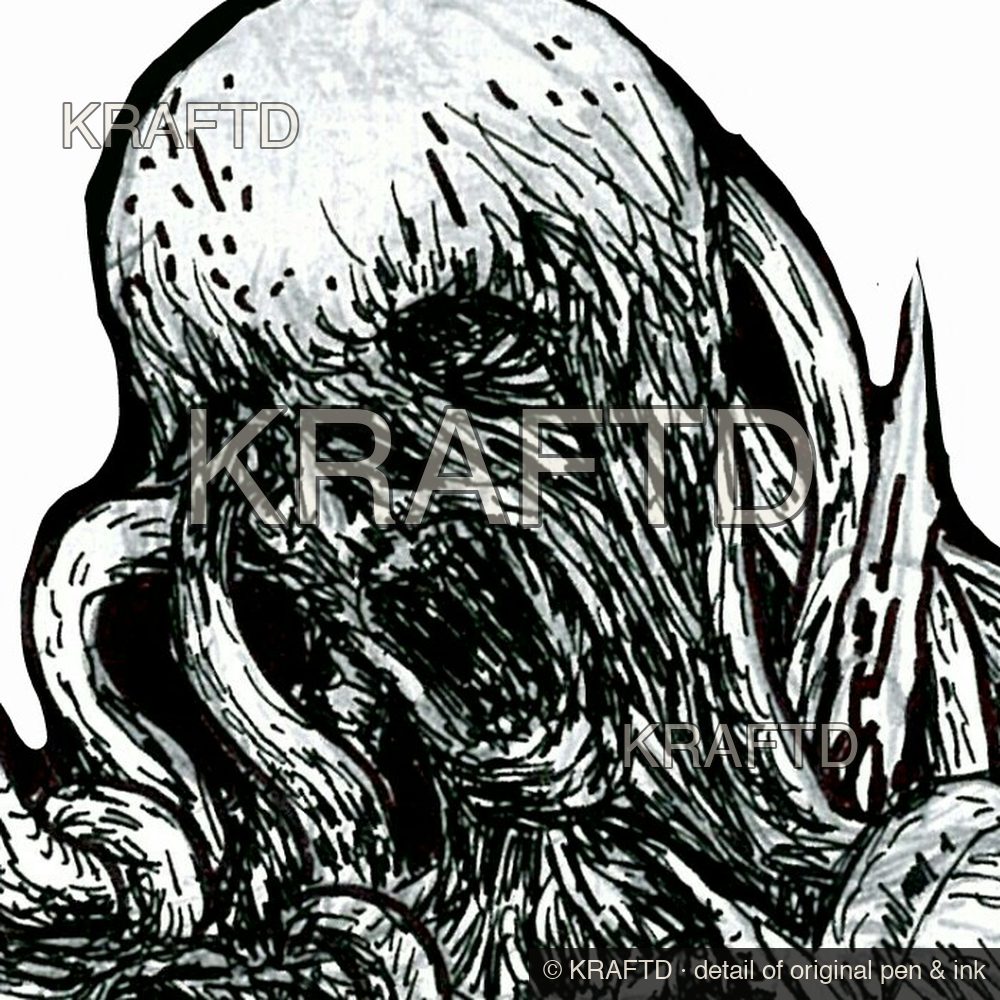
It starts with a pen and a blank page: no tablet, no tracing. The face comes first, a hollow, half-human head with its mouth hanging open in a silent howl and the skull stretched smooth like something that has never seen light. Every shadow is built from short strokes laid side by side, then crossed again where the dark needs to go deeper.
2. Building the texture
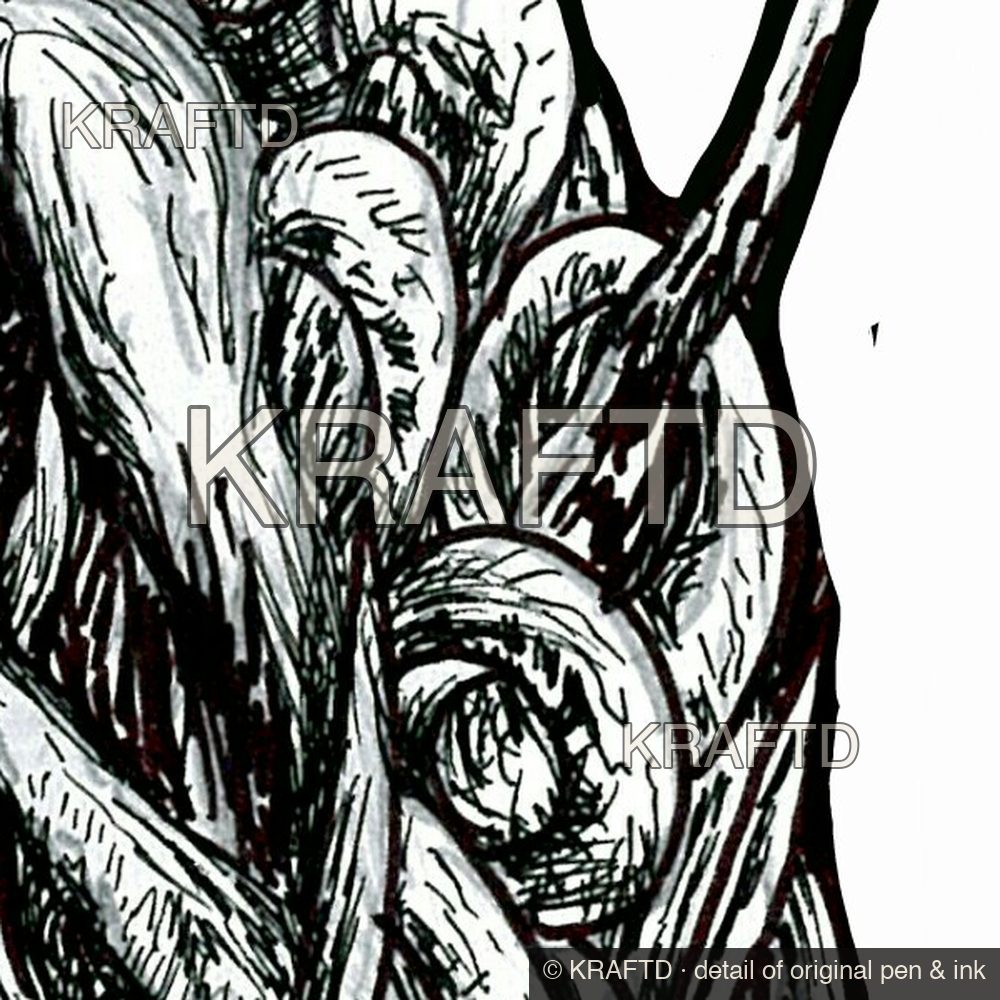
The body is mostly tendrils. Coils and feelers wrap the torso, crawl over the shoulders and pour down into a writhing mass, so it’s hard to tell whether the creature is made of them or being eaten by them. Each coil gets its own direction of hatching so it reads as round, and thorns break out of the outline to turn the silhouette into something like a crown, or a cage. This is the slow part. Nothing is a flat fill and nothing is a filter.
3. What’s buried at the base
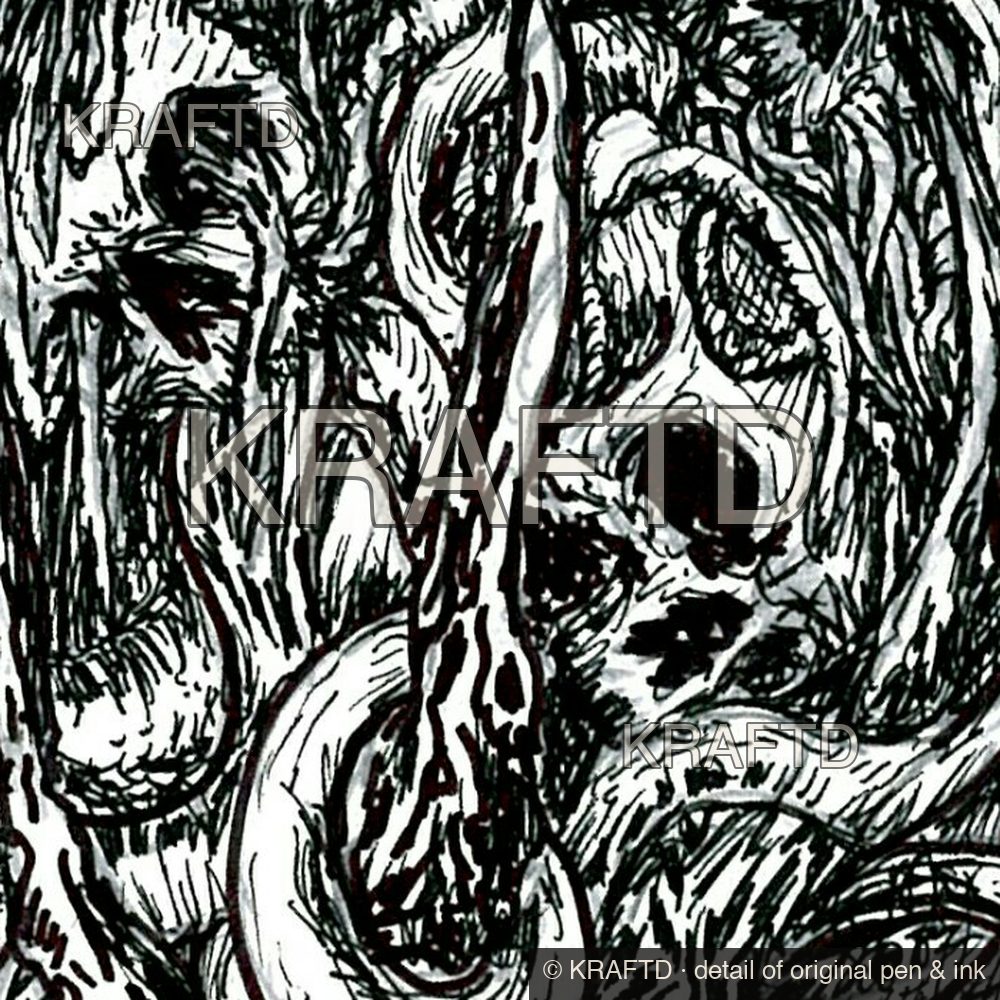
Down in the knot of flesh at the bottom are human skulls, the remains of whatever Behemoth has already swallowed. The demon of appetite, still digesting. That density of ink is what gives old death metal art its grit, the same grit you find on photocopied demo covers and gig flyers from the tape-trading days.
4. From paper to print
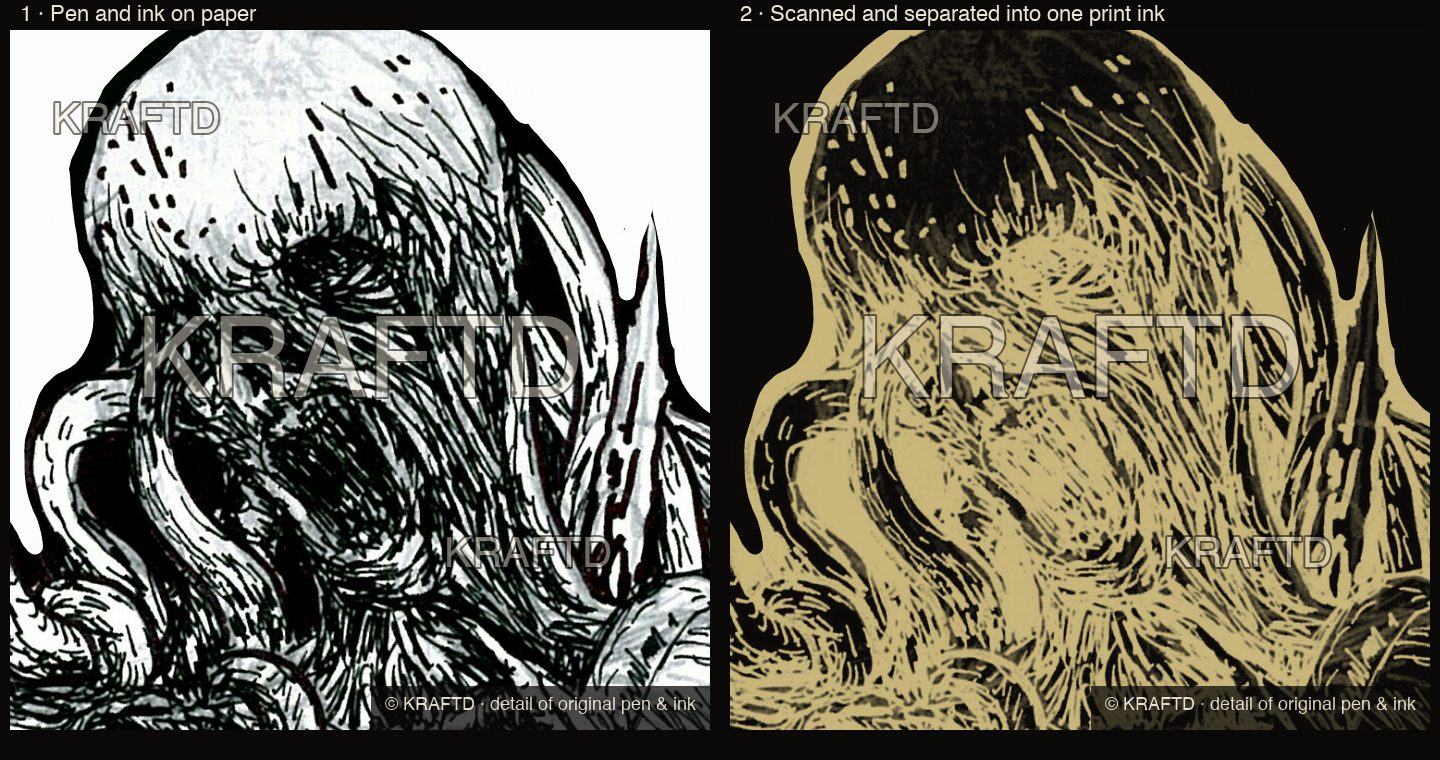
The finished sheet is scanned at high resolution and cleaned by hand, so specks of paper go and every stroke stays. Then the drawing is turned inside out: the inked lines become the print color and the white paper becomes the shirt. For this design that color is a single antique gold on black, which makes the creature look like it was engraved on an old gilded page.
Get the design
The Behemoth design is available on Amazon as a t-shirt, with hoodies, sweatshirts and more in several countries.
See the Behemoth design on Amazon →
More creatures from the same pen are in the KRAFTD design gallery and the death metal collection.
Behemoth: quick answers
What is Behemoth in the Bible?
A colossal land beast described in Job 40:15–24 as a creature of unmatched strength, with bones “like bars of iron”. It’s paired with Leviathan, the sea monster, to show the power of creation.
Is Behemoth a demon?
Not in the Bible itself. Medieval and Renaissance demonology later turned Behemoth into a demon of gluttony and appetite, and works like the Dictionnaire Infernal list and illustrate him.
What’s the difference between Behemoth and Leviathan?
In tradition, Behemoth rules the land and Leviathan rules the sea. Later Jewish legend adds Ziz, a giant bird ruling the sky.
Who drew the KRAFTD Behemoth design?
KRAFTD’s own artist drew it by hand in pen and ink. It was then digitized for apparel.
This design depicts the mythological Behemoth. It is not affiliated with, or endorsed by, any band or musical group.
As an Amazon Associate, KRAFTD earns from qualifying purchases.