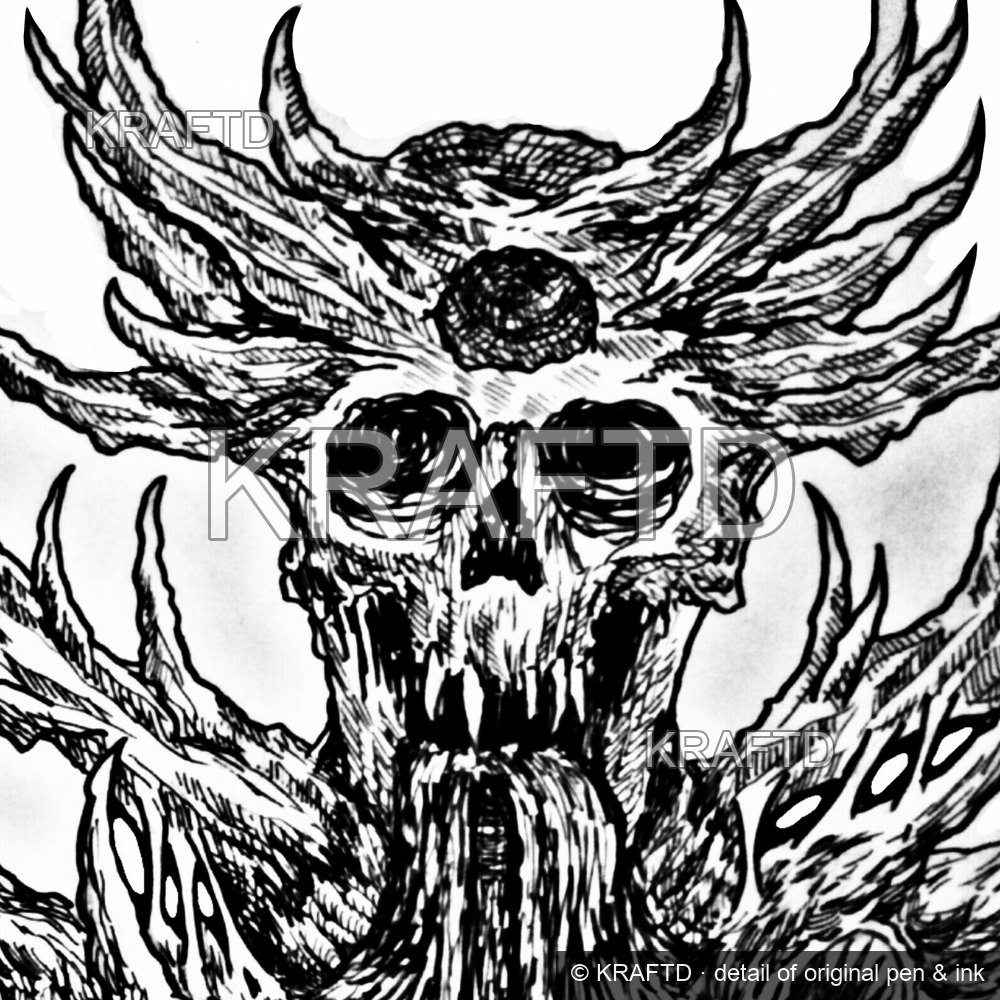
A skull is the oldest shorthand for death. Put one on a shirt and everyone understands it. But a skull that screams is something else. It isn’t a reminder that death is coming. It’s death refusing to keep quiet.
Our newest design is built around that idea: a skull with an extra eye, screaming out of a crown of horns, with more mouths and more eyes crawling in the tangle below it. Here’s where the image comes from, and how it was drawn.
Skulls that will not stay quiet
England has a strange little tradition of screaming skulls. In several old houses, the story goes, a skull has to stay inside the walls. Move it, bury it or throw it in the pond, and the house fills with shrieks, slammed doors and bad luck until it’s brought back.
The best known is at Bettiscombe Manor in Dorset, where a skull kept in the house was said to scream whenever anyone tried to take it away. At Burton Agnes Hall in Yorkshire, legend says Anne Griffith, a daughter of the house in the early 1600s, asked on her deathbed that her head be kept indoors. When the family ignored her, the noises began. Her skull is said to be bricked into a wall there to this day.
Other houses tell the same story. At Wardley Hall near Manchester, a skull kept on the staircase is said to belong to Ambrose Barlow, a Catholic priest executed in 1641, and to bring storms whenever it is moved. In Derbyshire, “Dickie”, the skull of Tunstead Farm, was said to guard the house and turn nasty when disturbed.
The legends were strong enough to become fiction. In 1908 the American writer F. Marion Crawford published The Screaming Skull, a ghost story about a skull that will not be silenced, and the title has been reused by horror films and stories ever since.
The common thread is simple: the dead don’t stay where they’re put.
The Screaming Skull on screen
In 1958 the legend reached the drive-in. The Screaming Skull, a low-budget American horror film directed by Alex Nicol, follows a newlywed who becomes convinced that a skull, and the ghost of her husband’s first wife, is haunting her new home. Its marketing famously offered a free burial to anyone who died of fright while watching. Decades later the film was lampooned on Mystery Science Theater 3000, which turned it into a cult favorite, and the screaming skull has stayed a horror staple ever since.
The extra eye
The skull in our design has three eyes. That’s older than horror.
In Hindu tradition, Shiva carries a third eye in the middle of his forehead. When it opens, it burns: in one story it reduces Kama, the god of desire, to ash. In yoga, the point between the brows is the ajna chakra, the seat of insight. In the 1600s, the philosopher René Descartes called the pineal gland, a tiny structure deep in the brain, the “principal seat of the soul”. Ever since, the extra eye has stood for seeing what others can’t.
Put that eye on a skull and the meaning turns dark. The dead thing is still watching. It sees more than you do, and it’s screaming about what it sees.
Death in the margins
European art had a name for this kind of image long before metal did. Medieval and Renaissance artists painted the memento mori, “remember you will die”, and Dutch painters of the 1600s filled their still lifes with skulls, guttering candles and rotting fruit. Those vanitas paintings were quiet and polite.
Old-school death metal art threw the politeness out. Its covers and gig flyers are crowded, ugly and loud: skulls with too many teeth, bodies fused into each other, every inch of the page filled with linework. The goal isn’t to remind you of death but to drag you into it. Our design comes straight out of that tradition.
How our artist drew it
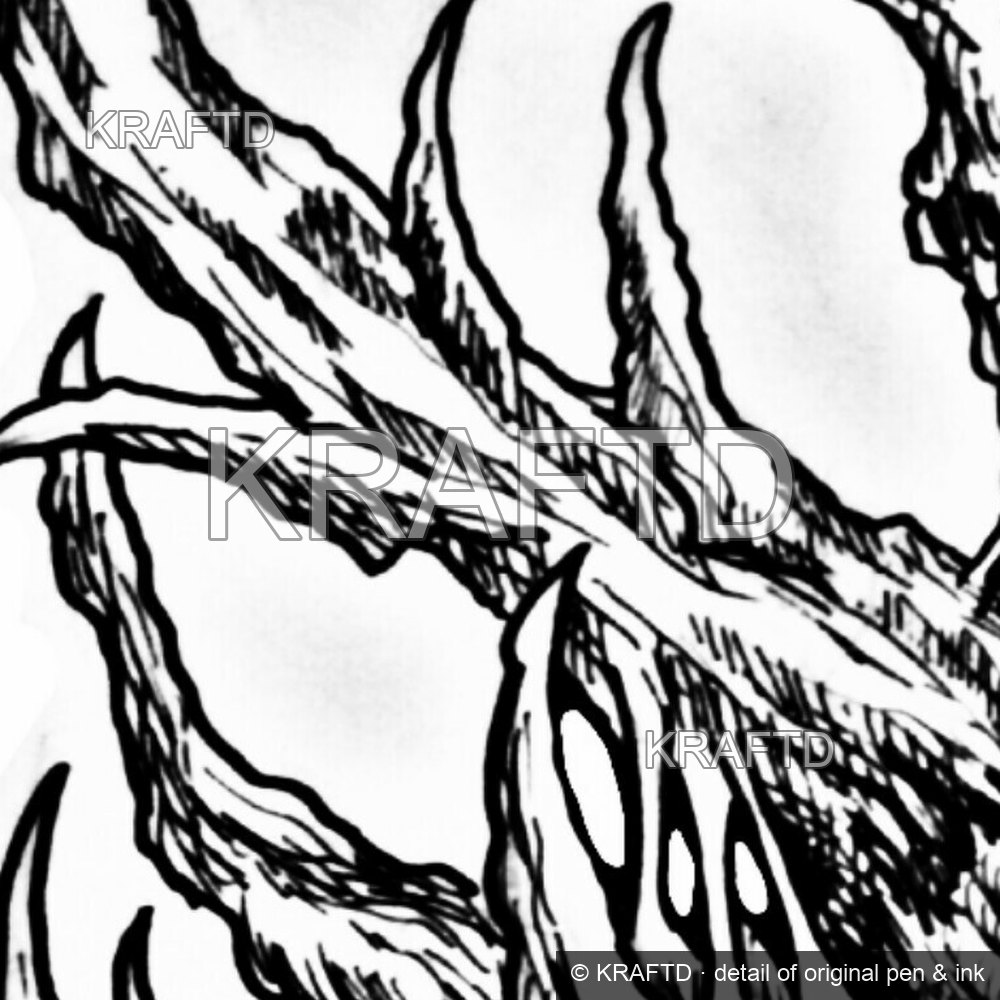
The drawing started as pen and ink on paper. Look closely and you’ll find:
- A crown of horns and spines. Curved horns fan out on both sides of the skull, layered like the petals of some dead flower, every one shaded with fine parallel hatching.
- The third eye. Above the empty sockets sits a single round eye, built from tight circular strokes until it reads as solid black.
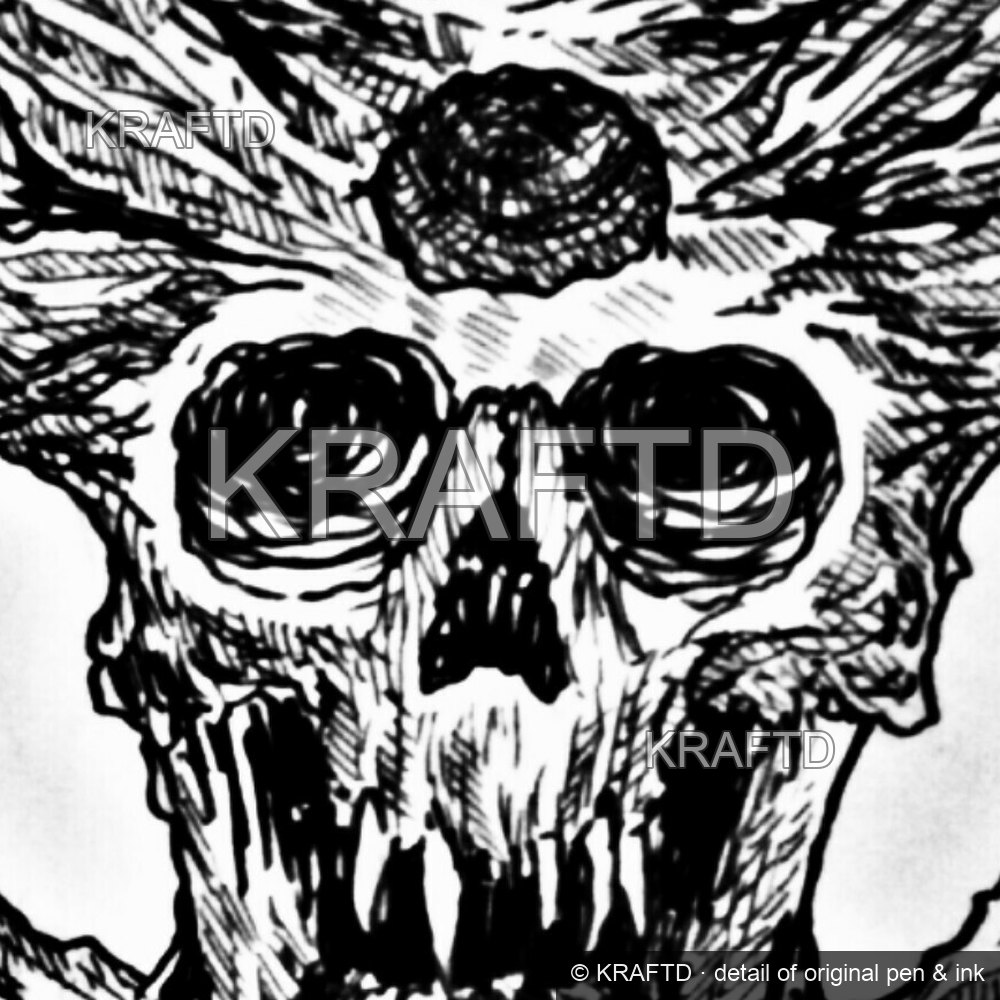
- A scream that keeps going. The jaw hangs open and the mouth pours downward into a column of dark, streaking lines, as if the scream itself had become part of the body.
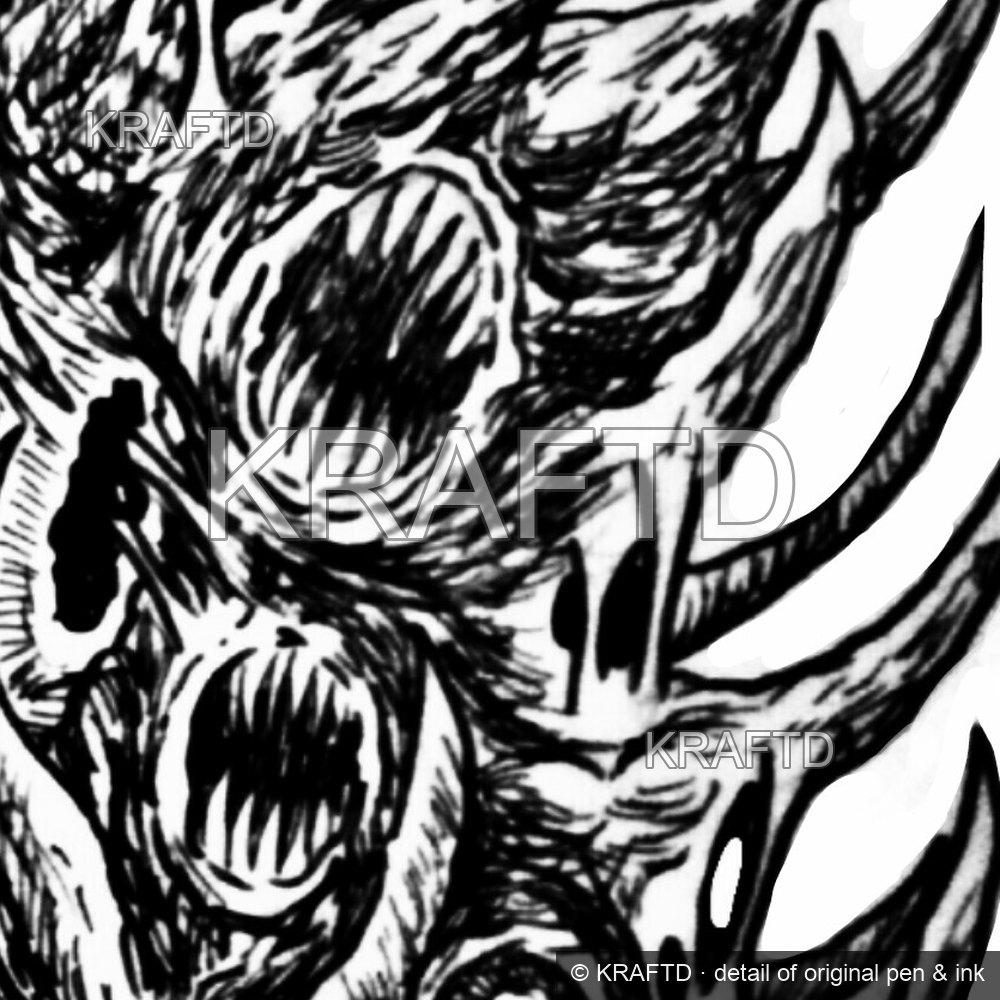
- More mouths in the tangle. Down in the roots, smaller fanged mouths open on both sides. Each one is screaming too.
- Eyes where there shouldn’t be any. Single eyeballs stare out from the knot of flesh at the bottom. The longer you look, the more faces you find.
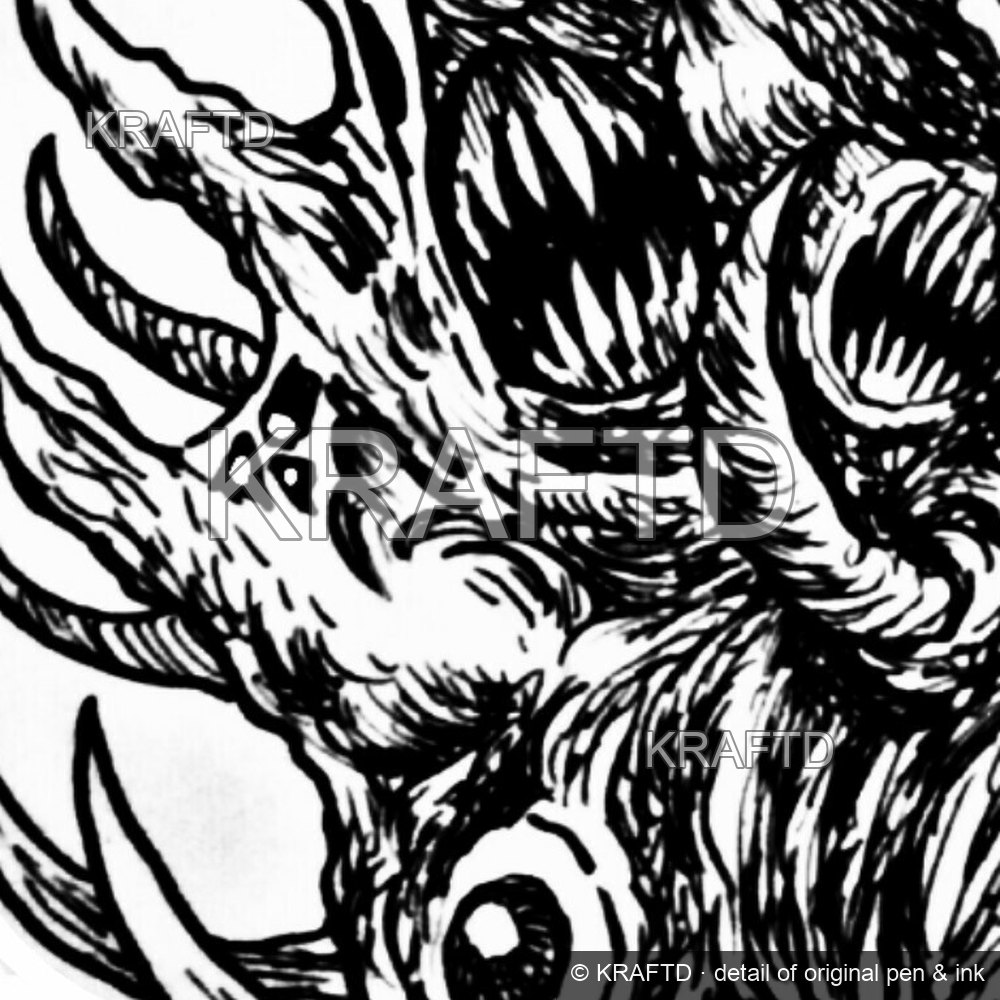
Every shadow in the piece is made from line: crosshatching, stippling and long parallel strokes, with no flat fills and no filters. That density is what gives it the grit of a worn demo-tape cover. We digitized the original drawing at high resolution so every stroke makes it onto fabric.
Why it lives on black
The design prints in white ink, so the shirt becomes the darkness. On black, the skull looks carved out of shadow: the white lines turn into bone and the black between them turns into depth. That’s why we offer it only in dark colors. The art was drawn to come out of the dark, so that’s where we keep it.
A tip for keeping a printed shirt sharp: wash it inside out in cold water, skip the high-heat dryer, and never iron directly over the print.
Get the design
The screaming three-eyed skull is available on Amazon as a t-shirt, hoodie and more, in the US and several other countries.
See the screaming skull design on Amazon →
More creatures from the same pen are in the KRAFTD design gallery and the death metal collection.
Screaming skulls: quick answers
What is a screaming skull?
A skull from English folklore that is said to scream, or bring bad luck, whenever it’s taken out of the house it belongs to. Bettiscombe Manor in Dorset and Burton Agnes Hall in Yorkshire have the best-known legends.
Is The Screaming Skull a movie?
Yes. The Screaming Skull is a 1958 American horror film directed by Alex Nicol, about a woman who believes a skull is haunting her new home. It later became a cult favorite after appearing on Mystery Science Theater 3000.
What does a three-eyed skull mean?
The extra eye comes from older traditions where a third eye means insight and seeing beyond the ordinary, such as Shiva’s third eye in Hindu tradition. On a skull, it suggests the dead are still watching.
What is memento mori art?
Art that reminds the viewer that death comes for everyone. Skulls, hourglasses and burnt-out candles are its classic symbols.
Who drew the KRAFTD screaming skull design?
KRAFTD’s own artist drew it by hand in pen and ink. It was then digitized for apparel.
As an Amazon Associate, KRAFTD earns from qualifying purchases.